Happy September. Q4 planning season is about to hand you a dozen documents that look like decisions and aren’t. Don’t get caught up in it. Instead, read what I’m sharing today.
A CEO I work with showed me one last week. One of his executives had built a prioritization spreadsheet for the team’s initiatives. Value scores, risk scores, weighted columns. It was well made, too.
Every initiative scored a nine or ten on value. Every risk was a three.
The CEO put it flatly: “He put the middle of the road for everything. He didn’t make a decision.” The spreadsheet had all the ceremony of rigor, columns, weights, math, and none of the substance, because the numbers had been chosen so that nothing would have to be cut, ranked below anything else, or defended.
That’s not analysis. That’s diplomacy with decimal points.
Here’s my favorite part, though. Not ten minutes later, the same CEO, staring at his own planning problem, said, “I have this urge to build a weighted table right now. I’m trying to resist it.” He caught it in the air. The reflex isn’t his executive’s personality flaw. It’s a thing humans do when a decision has losers and we’d rather it didn’t.
A spreadsheet can’t absorb the discomfort of a real choice. It can only postpone it, with formatting. The tell is uniformity: when everything scores high value and low risk, the document isn’t ranking your options, it’s protecting them.
So here’s a question for your Q4 planning stack. Find the last prioritization document your team produced and look at the spread. If the scores cluster in the safe middle, someone was avoiding a fight. Possibly with you. That’s worth knowing before you build a quarter on it.
And if you feel the urge to respond by building a better spreadsheet, sit with that for a second. I say this with love. The spreadsheet was never the problem.
If something in this week’s newsletter described a pattern you’ve suspected but couldn’t name, that’s exactly what Executive Triage is built for. One conversation. One pattern named with enough precision that you can’t unknow it. 90 minutes, an eight-page brief, $3,500. cynthiacorsetti.com/executive-triage
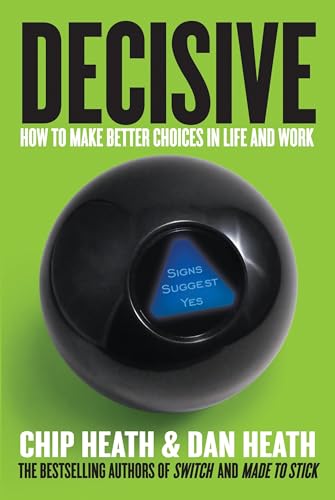
This week’s read: Decisive by Chip Heath and Dan Heath. The Heath brothers catalog the ways smart people rig their own decision processes without noticing, then give you four habits that actually interrupt it. The section on widening your options is the one I quote most. Find it here.
Every risk was a three. Sit with that.