
Hi, glad you’re here. It’s been a scorcher in Pittsburgh this year. Alex and I are heading to Maine to escape the heat for a bit this month. But, mid-summer has another trait in addition to extreme heat. It’s also the time when team friction surfaces. The cushion of being busy thins out, and people start noticing what they’ve been working around.
A client of mine has been in a hard stretch. Three of her direct reports have complaints about each other. One of them has been routing the complaint through her. Another has been routing it directly. The third one is the subject of both complaints, and she hasn’t said anything to him yet because she’s still trying to figure out what’s actually going on.
She told me about it almost as a logistics problem. Like she was trying to schedule a meeting that kept getting moved. I let her describe the situation for about ten minutes before I said anything. Then I asked her, “When did you become the person they tell instead of each other?”
She didn’t have an answer right away. She started to defend the structure, then stopped. Then she said, “Probably when I made it easy.”
Triangulation looks like leadership when you’re in the middle of it. People are bringing you the truth. You’re protecting them. You’re managing what gets said and to whom. What it actually is: you’ve become the connective tissue your team should be using on each other. You’re translating, smoothing, mediating. You’re also keeping them dependent on you to do it.
I caught myself doing this a few weeks ago with two of my contractors. They had a small misalignment about scope. Instead of telling them to talk to each other, I scheduled a call with each of them separately to “understand both sides.” By the time I was done, I’d made myself responsible for resolving a thing they could’ve handled in fifteen minutes. I knew better. I still did it. Because there’s something seductive about being the person who holds it all together.
My client’s question to me was the right one. “How do I stop being the person they triangulate through?” The honest answer isn’t a technique. You have to be willing to redirect every complaint back, every time, until your team learns that bringing it to you isn’t faster. Which means tolerating the discomfort of saying, “What did he say when you told him that?” and watching them realize they haven’t told him anything.
That part is harder than it sounds. Especially when you actually want to know what’s going on.
I don’t know which of your direct reports have been routing things through you. I do know you’ve started to feel like the central nervous system for conversations that aren’t yours. The temptation is to handle it. To smooth it. To manage who knows what. The cost is that your team is learning to come to you instead of going to each other. Every time. And that habit, once it’s set, takes a year to break.
If something in today’s newsletter described a pattern you’ve suspected but couldn’t name, that’s exactly what Executive Triage is built for. One conversation. One pattern named with enough precision that you can’t unknow it. $3,500. cynthiacorsetti.com/executive-triage
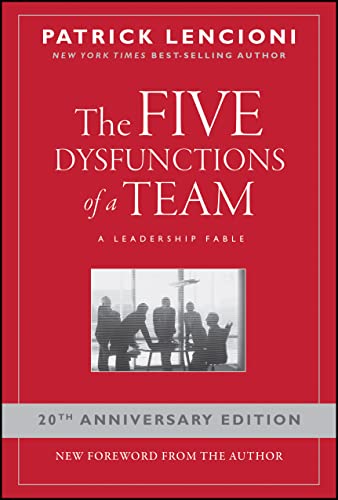
This week’s read: The Five Dysfunctions of a Team by Patrick Lencioni. The chapter on fear of conflict maps almost exactly to what triangulation creates. It’s written as a business novel, which sounds gimmicky and isn’t. The section on artificial harmony is where I’d start. Find it here.
The hardest part of leading a team is not being the team’s primary relationship.